
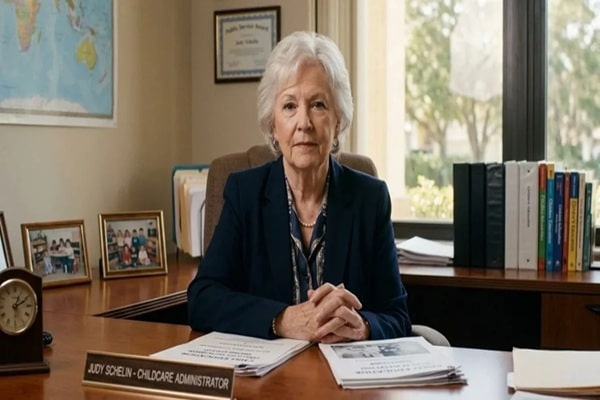
Most people become famous for their success. Judy Schelin became known for something else entirely. Her name appears in court records, investigative reports, and news articles. But none of those stories celebrate her achievements. Instead, they tell a difficult story about broken trust, federal bribery, and a system that failed to protect vulnerable children.
Judy Schelin worked in Florida’s childcare sector for years. She managed programs that fed low income children. She ran daycare centers. She held positions of real responsibility. Yet behind that professional image sat a pattern of misconduct that eventually caught up with her. Her story matters because it exposes gaps in how we oversee programs meant to help the most vulnerable people.
This is not a celebration of her life. It is an examination of what happened, why it mattered, and what lessons remain. Her legacy is not one of fame or fortune. It is a warning about what happens when personal gain replaces public service.
Early Years in Iowa
Judy Lynn Schelin was born in December 1951 in Merrill, Iowa. That small Midwestern town sits far from the Florida controversy that would later define her life. Her early years were quiet and unremarkable. She grew up in a conventional American household during the 1950s and 1960s.
Eventually, she left Iowa and moved to Florida. That move changed everything. Florida offered opportunities in the growing childcare and nonprofit sectors. Schelin seized those opportunities. She built a career managing programs that served thousands of children across Broward, Palm Beach, and Miami Dade counties.
Her ambition was clear from the start. She wanted leadership roles. She wanted to control large budgets. And she found ways to get both. But ambition without ethics creates problems. Those problems would surface years later.
Building a Career in Childcare
During the 1990s and early 2000s, Judy Schelin became a known figure in Florida’s childcare administration. She served as executive director of Riverwood Youth Opportunities. That nonprofit managed USDA funded meal programs for roughly 200,000 low income children. The scale was massive. The responsibility was enormous.
She also operated several daycare centers in Broward County. These centers served hundreds of children daily. State and federal subsidies flowed through her organizations. She controlled millions of dollars in public funds. That level of trust should have come with careful oversight. But oversight was weak.
Schelin presented herself as a dedicated public servant. She talked about helping children and supporting families. Some people believed her. Letters of support submitted during her court case described her as generous and community oriented. But those descriptions clashed sharply with what investigators eventually uncovered.
The Bribery Scheme Uncovered
The turning point came in 2010. Judy Schelin pleaded guilty to federal bribery charges. She used the name Judy Perlin in court records, which later allowed her to hide her past. Prosecutors proved she accepted roughly $40,000 in kickbacks from a catering company called Diana Food Group.
The scheme operated between 2003 and 2005. Schelin used her position to secure the catering company’s participation in a federally subsidized food program. In exchange, she received illegal payments. This was not a small mistake or a technical violation. It was deliberate corruption.
Investigators found more than just bribes. They discovered serious deficiencies in her management practices. She paid approximately $20,000 in salaries to family members using federal funds. She used program money to advertise her daughter’s private business in a national publication. These actions showed a pattern of treating public resources as personal property.
The Court’s Lenient Sentence
Given the severity of her crimes, one might expect a harsh punishment. Schelin faced the possibility of ten years in prison. But the court imposed something much lighter. She received two years of probation and a $3,000 fine. That was it.
The court also banned her from participating in USDA funded programs for seven years. That ban seemed significant at first. But later events proved it had serious loopholes. Schelin found ways to continue working in childcare despite the ban. The system failed to track her effectively.
Many people following the case expressed frustration. A convicted felon who stole from programs meant for hungry children walked away with probation. The message sent was troubling. It suggested that financial crimes against public programs carried minimal consequences.
Financial Mismanagement Beyond Bribery
The bribery conviction was not an isolated incident. Prior to federal charges, state investigators had already flagged serious problems. Auditors found that Riverwood Youth Operations submitted improper billings to the state. The questionable expenses included luxury car leases, resort stays, and travel unrelated to childcare programs.
Schelin reimbursed some of these expenses voluntarily. But she fought other findings, claiming she misunderstood the rules. Investigators also discovered she kept more administrative fees than state guidelines allowed. She used program offices to support family run businesses.
An administrative law judge ordered her to repay nearly $150,000 to daycare centers and additional funds to the state. These findings painted a clear picture. Schelin consistently pushed the boundaries of acceptable behavior. She treated public programs as personal cash machines.
The 2015 Boca Raton Controversy
After her conviction and probation ended, Judy Schelin returned to childcare work. In early 2015, she became an infant program teacher at Congregation B’Nai Israel in Boca Raton, Florida. She applied under the name Judy Schelin, not Judy Perlin.
She passed background checks conducted by the Florida Department of Children and Families and the Palm Beach County Sheriff’s Office. Those checks showed no arrest history because her federal conviction was recorded under a different surname. She also signed a sworn affidavit stating she had never faced disciplinary action or fines.
When local media discovered her true identity, the reaction was immediate and angry. Parents could not believe a convicted felon was caring for their infants. The school initially defended her, calling her care superb. But the public outcry could not be ignored. She was terminated in January 2015.
Regulatory Gaps Exposed
The 2015 controversy revealed serious weaknesses in Florida’s childcare oversight system. Officials admitted that bribery is not among the crimes that automatically disqualify someone from working in daycare centers. The law simply did not address financial crimes in the same way it addressed violence or abuse.
The Early Learning Coalition of Broward County stated there was little they could do under existing statutes. Even state spokespeople acknowledged the situation highlighted an oversight needing reform. But change comes slowly. Meanwhile, children remained in facilities managed by someone with a federal bribery conviction.
This gap in the system frustrated nonprofit administrators and watchdog groups. They called for legislative reform. They wanted background checks to include all criminal history, not just specific categories of offenses. The Schelin case became a textbook example of why such reforms were necessary.
A Complex Personal Identity
Judy Schelin has used multiple surnames over the years. Records show she has gone by Perlin, Balzano, Albert, and Schindel. She reportedly married a man named Gary Schindel. This pattern of name changes complicated background checks and public records searches.
Her family played a visible role in her organizations. Investigators noted that relatives were often employed by the nonprofits she managed. Some also benefited from administrative decisions. These family connections became a focal point of official inquiries.
Despite the legal troubles, some people continued to support her. Character references submitted during sentencing described her involvement in foster care and charitable work. These testimonials suggested a more complex person than the one portrayed in court documents. She may have genuinely helped some people while also breaking the law.
Where She Lives Now
As of 2026, Judy Schelin reportedly lives in Delray Beach, Florida. She is said to work as a payroll manager rather than in childcare administration. That represents a significant step down from her former executive roles.
Her lifestyle appears more subdued now. The luxury cars and resort stays are likely gone. She has retreated from public attention. The media no longer writes about her. She has become a private citizen again, just as she was before the scandals broke.
But the impact of her actions continues. Lawmakers and regulators still cite her case when arguing for stronger oversight. Parents remain more skeptical of childcare providers. The trust she broke has not fully healed.
What Is Judy Schelin’s Net Worth?
Estimating Judy Schelin’s net worth is difficult. Public records do not provide clear financial disclosures. However, available information suggests her net worth falls between $150,000 and $250,000.
During her peak years, organizations she managed controlled roughly $1.2 million annually in state and federal funds. But that money was operational, not personal. Her personal wealth appears modest. The luxury expenses uncovered by investigators were paid through program funds, not her own pocket.
Her current role as a payroll manager likely provides a modest income. She does not appear to have accumulated significant personal wealth from her years in childcare administration. The money she improperly used went to operational expenses, family members, and perks, not to building personal assets.
Lifestyle Choices and Public Perception
The public knows two different versions of Judy Schelin. One version is the convicted felon who accepted bribes and manipulated public programs. The other version is the community supporter who helped foster children and volunteered for good causes.
Both versions contain some truth. People are complicated. Someone can do genuine good in some areas while breaking laws in others. But when public funds and vulnerable children are involved, the bad actions outweigh the good. That is the calculation most people have made about Schelin.
Her lifestyle today reflects a desire to avoid attention. She does not seek media coverage or public roles. The ambition that drove her earlier career has faded. She lives quietly, likely hoping people forget her name.
Also Read : Leon Russom Biography: Career, Net Worth, Family, and Prison Break Role
Lessons for Childcare Oversight
The Judy Schelin case offers clear lessons for policymakers. Background checks must be more thorough. Name changes should not allow convicted individuals to hide their past. Financial crimes should trigger automatic disqualification from programs serving children.
States need better data sharing between agencies. The fact that Schelin passed background checks under one name while having a conviction under another name is unacceptable. Modern systems should flag such discrepancies automatically.
Legislators in Florida and elsewhere have proposed reforms based partly on cases like hers. But progress is slow. Budget constraints and political disagreements delay changes. Meanwhile, the risk remains that other individuals with similar backgrounds could slip through the cracks.
Final Thoughts on a Damaged Legacy
Judy Schelin’s story is not one of success. It is a story of lost trust, broken rules, and inadequate systems. She held positions that should have gone to people with clean records and strong ethics. Instead, she used those positions for personal gain.
Her legacy is a warning. It reminds us that public programs need constant vigilance. It shows how one person can exploit gaps in oversight. And it demonstrates that even after conviction, problems can continue if systems do not communicate with each other.
The children and families she was supposed to serve deserved better. The taxpayers who funded those programs deserved better. And the childcare industry deserved better than to have its reputation damaged by someone who put personal gain above public service.
Judy Schelin will never be remembered as a role model. But her case can still serve a useful purpose. It can push lawmakers to close loopholes. It can make parents more careful. And it can remind everyone in public service that trust is hard to earn and easy to lose.